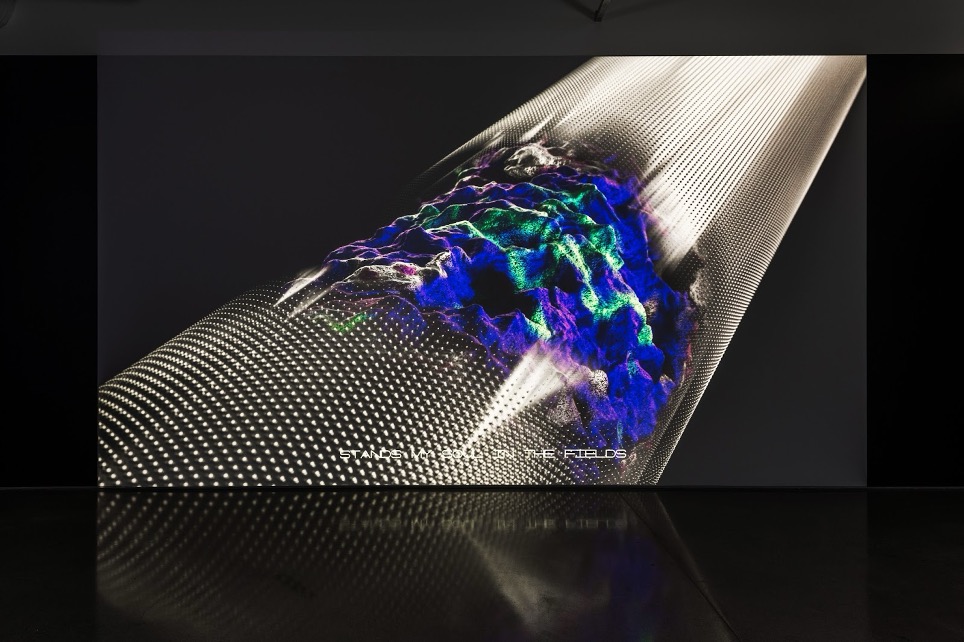
Lesia Vasylchenko is an artist working with moving image, installation, and media archaeology. Her practice explores chronopolitics: how time is controlled, experienced, and shaped through planetary sensor networks and imaging infrastructures. She examines how computation increasingly organises social life—how observation technologies structure duration and determine what can be registered, archived, or forecast. As part of her artistic research, she develops speculative concepts such as Tachyonic Data, Chronoesthetic Wound, and Chronosphere to propose how past, present, and possible futures can overlap—and how computational systems process them to organise the world.
In Chronosphere, Lesia Vasylchenko presents time as a planetary “envelope” shaped by overlapping rhythms—human and more-than-human, natural and artificial. Signal speeds, satellite sensing, and computational cycles meet geological deep time, environmental change, slow violence, and the trauma of war. Her installations translate these collisions of scale into visual and spatial experiences that reveal the politics of a hypersynchronised world.
Her work engages satellite constellations, near-real-time data, and remote-sensing systems that operate beyond human perception. These technologies shift sensing from the body to computation, producing a gap between lived time and synthetic time. Within that gap, archived and unarchived histories, the present, and imagined futures collapse into an expanded now.