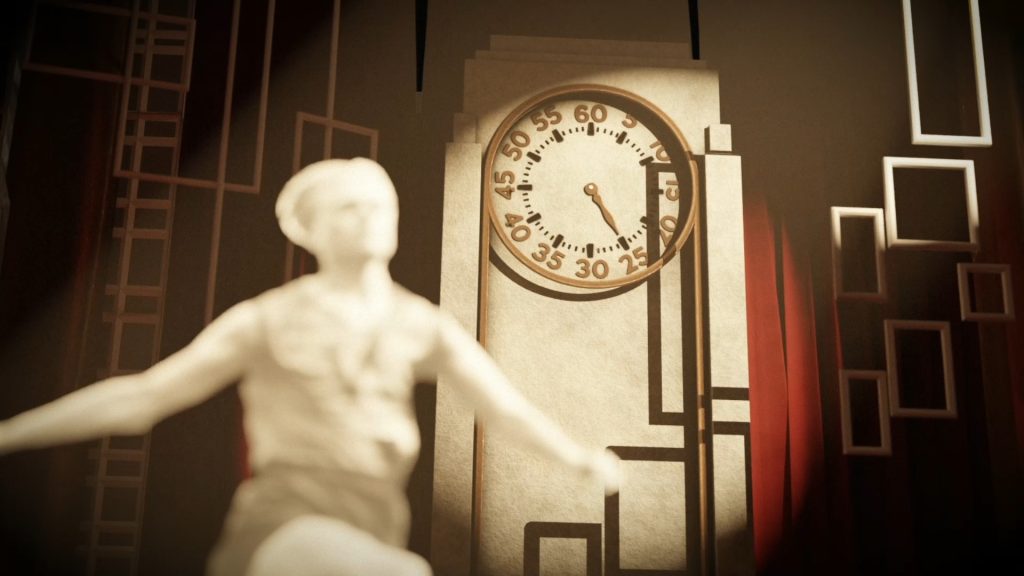
On entering Ezra Šimek’s installation Every Day, Every Week Another Historical Image Floods Our Screens , the eye is initially directed towards a mirror, a red curtain and a projection. An 18-minute succession of three video sequences unfolds, accompanied by a varied soundtrack mainly of Ezra Šimek speaking.
In the first scene an athletic figure slowly stands up. On closer inspection, and as the soundtrack explains, this is revealed to be the historical Czechoslovakian athlete Zdeněk Koubek. There is a clock in the background, and a red curtain moving to the right and left intensifies the impression of a stage setting.
The second sequence shows the opening ceremony of the Olympic Games in Paris in 2024. A pier on the Seine marks the location. All that can be seen are a horse’s head and neck and the silhouette of a female rider – the portrayal of Joan of Arc in the ceremony. Joan fought in male armor and questioned established power structures, as the soundtrack emphasizes.
In the third sequence a boxer – probably the Algerian Imane Khelif, who won the gold medal in Paris – raises her bandaged arm in victory. Cameras flash in the background. The date 2024 and the Olympic rings can be seen.
The three sequences gradually coalesce into a wider context. The sporting and Olympian motifs aren’t staged and deconstructed in slow motion for their own sake. The soundtrack refers to the historical case of Zdeněk Koubek (1913–1986), an initially extremely successful Czechoslovakian athlete whose titles were all revoked following gender reassignment. Zdeněk Koubek moved between different spheres, later going from the sports arena to the cabaret stage. Imane Khelif was subject to hateful sexist comments after her victory, which was put in doubt as she didn’t conform to stereotypical ideas of femininity.
The 2024 Olympic Games in Paris exemplify the exclusions and social distortions both inside and outside the sports system. In urban space, this was manifested in the displacement of homeless people from the city center. In sports, unresolved legal conflicts around gender identity stand out along with the still prevailing binary categories, which were institutionally tightened in the light of National Socialist ideology from the 1930s onward – within our reach historically in the case of Zdeněk Koubek and highly topical with Imane Khelif.
The soundtrack – also available as a printout in the exhibition – combines applause, an extract from a historical interview with Zdeněk Koubek, singing from a crackling record, personal memories, and passages adapted from the book The Other Olympians (2024), by Michael Walters, about Zdeněk Koubek and the treatment of trans* and intersexual people in sport, read by Ezra Šimek. The various levels of meaning are woven together by a mesmerizing and melancholy form of visual nostalgia.
At the same time the red curtain and the mirror in the exhibition space form a bridge to Ezra Šimek’s current research, in which, as the artist explains, musicals and joy are seen as a “political act”, as the seismograph of particular social tension – “A counter-archive. A place where marginalized histories don’t just survive; they sing.” A dressing room in this context isn’t just a place to put on make-up and change costumes. For Ezra Šimek it’s primarily a safe space, a place to retreat to, but also of boundary-pushing and transgression where change is possible and desired. The mirror has a key position here as the self-assurance of transformation in places where identities are taken on and then publicly acclaimed. What is impossible in many social contexts is given its own space here. In the video Ezra Šimek formulates it as follows: “Imagine being your true self, without having to answer to anybody – maybe we’ll get there in my lifetime.” Curtains. Applause!
Text: Valeria Schulte-Fischedick


