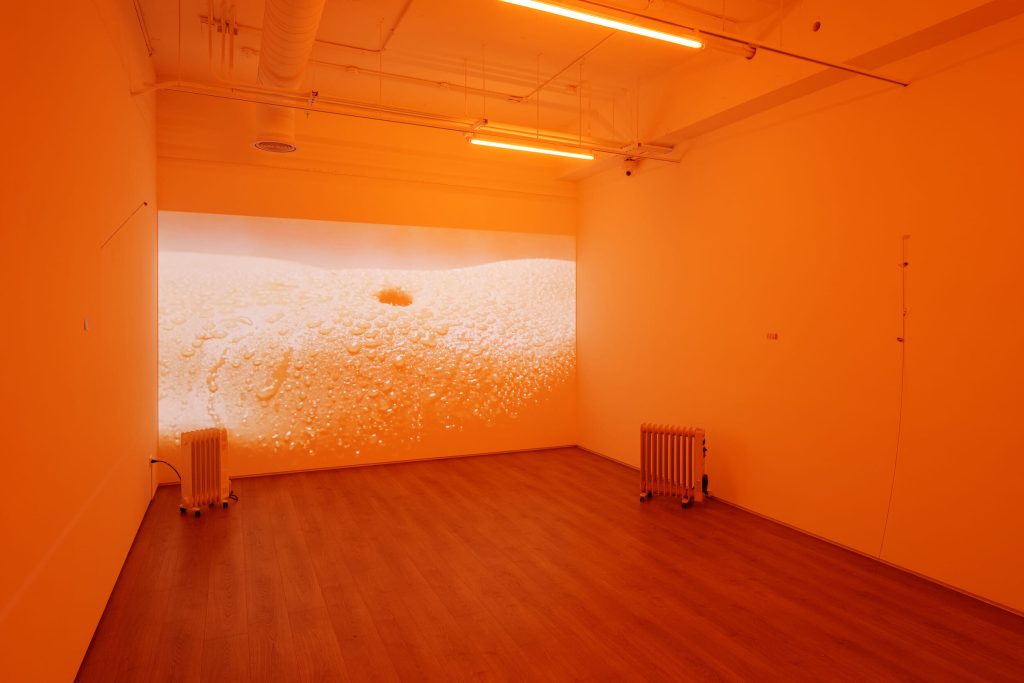
Esther Yi-Chun Lin’s practice explores how memories, histories, and personal experiences are carried through bodies, objects, and everyday gestures. Working across performance, installation, moving image, and text, they investigate subtle forms of presence and traces of individual lives that often remain unnoticed or difficult to capture.
Many of Esther Yi-Chun Lin’s works take shape at the intersection of ordinary situations, personal objects, and systemic logic. Through acts of collecting, reenacting, walking, and sensory observation, they trace how individual lives navigate, absorb, and subvert broader mechanisms of control and record-keeping. Their performances and installations unfold through simple gestures and durational actions, prompting us to re-examine what has been normalized, left unarchived, or preserved only as an embodied absence.
A central aspect of Esther Yi-Chun Lin’s practice is their exploration of the body and the everyday as counter-archives of memory and experience. Rather than treating the body as a passive repository, they approach it as an active interface through which knowledge can be produced, dominant narratives questioned, and new lines of inquiry generated. Through smell, touch, movement, and other ephemeral forms of embodied perception, they investigate traces of lived experience that cannot easily be recorded or preserved. These approaches allow them to consider how personal experience resists flattening by structures of power, particularly within Taiwan’s layered historical contexts and colonial entanglements. Their work reflects on how memories are transmitted, transformed, and embodied, and how incomplete histories might be approached through attentive and speculative processes of reconstruction and reenactment.